Greenwashing Chronicles: A Buyer's Guide to Commercial Food Waste Dehydrators
Written for the people who actually sign these purchase orders — school district facilities managers, hospital sustainability officers, university dining directors, procurement staff at any organization being pitched an on-site food waste machine. If that's you, this will take fifteen minutes and may save you five or six figures.
Greenwashing Chronicles: A Buyer's Guide to Commercial Food Waste Dehydrators
Written for the people who actually sign these purchase orders — school district facilities managers, hospital sustainability officers, university dining directors, procurement staff at any organization being pitched an on-site food waste machine. If that's you, this will take fifteen minutes and may save you five or six figures.
I'm a compost maker. I teach farmers, land managers, and organizations how composting actually works, and I've spent years making compost from food waste at scale.
So when an organization asks me whether an on-site food waste machine will solve their problem, I have a specific and narrow expertise to offer: I can tell you what the output of these machines is, what it isn't, and what you'll be able to do with it on Monday morning.
That last question — what you will actually do with the output — is the one that decides whether these purchases succeed or fail. It's also the one that gets the least attention during the sales process.
First, get the words right
There's a lot of loose terminology in this market, some of it careless and some of it deliberate, and you can't evaluate a pitch if you don't know what category of machine you're being sold. The EPA's 2021 issue paper on commercial food waste pre-processing technologies sorts them into five types, and it's worth learning them:
Grinders mechanically macerate food waste into a slurry, usually sent down the drain.
Biodigesters — also called aerobic digesters or liquefiers — use added microorganisms, water, and oxygen to break food waste into a liquid, also typically sent down the drain. These require proprietary microbe or enzyme supplies on an ongoing basis.
Pulpers press the water out mechanically, producing a semi-dry pulp.
Dehydrators use heat to evaporate the water, producing a dry ground material.
Aerobic in-vessel units mix food waste with bulking material like sawdust or wood chips and use actual aerobic decomposition to produce a semi-dry product that still requires curing.
These are genuinely different machines with different inputs, different failure modes, and different outputs. Anyone criticizing them — including me — owes you the precision of naming which one they mean.
This piece is about dehydrators, the category most commonly marketed to schools and institutions, and most commonly described in sales materials as producing compost or a soil amendment.
Note also the last category. Aerobic in-vessel units really do decompose material biologically. Even those, per EPA, produce something that needs further curing before use. If a technology that actually composts still isn't finished in a week, a technology that doesn't compost at all isn't finished in twenty-four hours.
What a dehydrator does
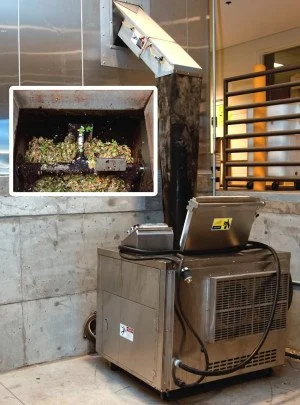
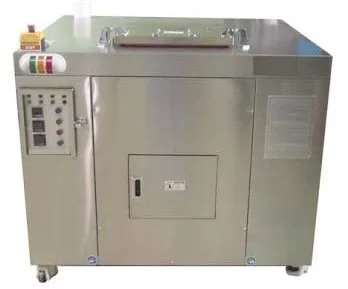
It grinds food waste and heats it until the water evaporates. The steam is condensed and sent down the drain. What's left is dry, ground-up food, reduced by roughly 80 to 93 percent in weight and volume.
That's the whole mechanism. Grinding and heating. No microbes are required and none are involved — which, to be clear, is what the better manufacturers say themselves. A dehydrator is a dehydrator. The technology isn't the problem.
The claims made about the output are the problem.
The claims, in their own words
This isn't a characterization of what salespeople say. BioCycle, the organics recycling trade publication, went through the sales literature and interviewed the vendors directly. Here's what's actually being marketed:
Two slogans recur across the dehydrator category. One is "Food Waste In, Compost Out". The other promises potable water as the second output.
On the solid material: EcoVim's literature has described the end product as usable as a soil amendment suited to landscaping. Somat's has called it ideal for use as a soil amendment. Gaia is the outlier and deserves credit for it — its literature describes the output as sterilized, dehydrated material and recommends having it analyzed to determine an appropriate application. That's an honest description of an honest product.
Now hold those claims against what CalRecycle, the EPA, the US Composting Council, and the peer-reviewed research say below. The gap between them is the entire subject of this article.
The word they use themselves
There's one detail in that marketing worth stopping on, because it gives the whole thing away.
Somat's literature advertises that the processing chamber heats the waste and kills bacteria. BioCycle, describing a typical unit's performance, refers to the solid output as sterile organic biomass. Gaia calls its output sterilized.
They are advertising sterility as a feature.
And sterility is precisely, exactly, the property that makes this material not compost. Compost is alive. Its entire value — building soil structure, making nutrients available to plants, suppressing disease — comes from the living community of microbes, fungi, and invertebrates that did the decomposing and stayed. A material that has been heated until nothing survives in it is not partway to being compost. It has been moved in the opposite direction.
So when a vendor tells you the machine sterilizes the waste and also tells you the output is a soil amendment, they've made two claims that cancel each other out. Ask them which one they'd like to keep.
What the regulators and the industry say
You don't have to take a composter's word for any of this. Three independent bodies have addressed it directly:
CalRecycle, the California agency that regulates this space, states plainly that dried food waste is not compost or a compost product, because dehydrators do not biologically decompose food waste into a stable substance. CalRecycle also notes that if the dried material gets wet again, it reabsorbs water and regains characteristics of unprocessed food waste — including odor and attraction of vectors.
The EPA, in the issue paper cited above, states that the soil amendments produced by dehydrators and aerobic in-vessel units are not compost in the traditional sense, and that much remains to be learned about their stability and suitability for different uses. EPA further notes that the dry output is not stable enough to be used directly as a soil amendment and requires curing or further processing at a composting facility first.
The US Composting Council, the industry's own trade body, has taken the position that food dehydrators are not composters, that their output is a feedstock for composting rather than compost itself, and that these products should stop using the word "compost" in product names, marketing, and descriptions.
If a salesperson tells you their machine makes compost or produces a ready-to-use soil amendment in twenty-four hours, they are making a claim that a state regulator, a federal agency, and their own industry association have each specifically contradicted.
That is the false claim. That's the one.
What the research shows
Two studies are worth knowing about, because they're the closest thing to direct evidence on the question you care about.
Loyola Marymount University evaluated whether the output of its dining hall's dehydrator was suitable as a landscaping soil amendment. It did not break down the way compost does. Fungal growth increased over time. It attracted flies. EPA reproduces a photo series of the fungal colonization in its report.
Schroeder et al. (2020), peer-reviewed, ran food waste from a restaurant, cafeteria, grocery store, hospital, and juice manufacturer through a commercial dehydrator and characterized the output against a range of possible end uses. Their finding: the material was not suitable for direct use as fertilizer, across every input stream they tested. It was, however, well suited as a composting feedstock, as fish feed and cattle feed, and as fuel.
Read that finding carefully, because it's the most useful sentence in this entire literature. The material has real value — as an input to something else. What it does not have is value as a finished product you spread on the ground.
One more thing, because NPK panels get waved around in these conversations as though they settle the matter. Nutrient content is not nutrient availability. Elemental composition tells you what is present in a sample. It tells you nothing about what a plant can take up, and nothing about biological stability — which is the actual question on the table. Schroeder et al. skipped the proxy and tested the end uses directly. Direct fertilizer application failed.
The rewetting problem
This is the property that determines everything about how you'll have to store and handle this material, and it rarely comes up in a sales meeting.
Dehydration doesn't process food waste. It pauses it. Remove the water and biological activity stops; add water back and it resumes. CalRecycle says this. EPA says this. Every composter who has handled the material says this.
The practical consequences for an institution:
It has to be kept dry in storage, which means covered, indoor, or containerized space you may not currently have.
Applied to the ground outdoors, it will get rained on. See the LMU findings: fungal growth, flies.
Curing exists precisely to prevent this. EPA describes curing as the process of allowing dehydrator output to mature and stabilize over time — often a few weeks — to prevent odors, large fungal colonies, and attraction of disease vectors.
So if you're told the output is ready to use immediately, ask why the EPA thinks it needs weeks of curing.
What it costs to run
Energy is the line item most often glossed over in a sales meeting, and it's the one that varies most.
Per EPA, dehydrator energy use ranges from 1.8 to 700 kWh per cycle, with cycles running 8 to 22 hours, depending on model and capacity. That's a spread of roughly four hundredfold across the category.
Which means any general claim about what "these machines" cost to run — from a vendor, from a competitor, from a critic — is meaningless. There is no category number. There is only your machine's number, and you can get it yourself in five minutes:
kWh per cycle (from the spec sheet) × cycles per year × your actual utility rate.
Then hand that figure to your facilities team and ask what it does to the building's peak demand charges. That's usually where the unpleasant surprise lives, and it rarely appears in a vendor's cost comparison.
One caution about the spec sheet. EPA notes that essentially all published performance data for this equipment — processing capacity, weight reduction, energy consumption — originates with the manufacturers and has not been independently verified. Ask for the numbers in writing regardless. A vendor who will put them in writing is telling you something. A vendor who won't is telling you more.
Two operational details that surprise people
These are batch machines. A dehydrator runs an uninterruptible cycle of eight to twenty-two hours. Food waste generated while a cycle is running has to go somewhere, which means you need interim storage — refrigerated or containerized, depending on your climate and your health inspector. Some operations solve this by buying a second unit. Ask where the staging happens before you're told it's not a problem, because it's the kind of thing that gets discovered after installation.
The water goes down your drain. That 250-pound example produced about 25 pounds of solids and roughly 25 gallons of condensate, which is captured as vapor, reconstituted, and discharged to the sewer. That liquid carries measurable biochemical oxygen demand. Some vendors have claimed it's potable — one salesperson was reported to drink it during sales calls — but a claim like that deserves a lab test rather than a demonstration.
Nobody counts this stream in the sustainability math. It's worth asking your facilities team whether your building's drain discharge is subject to any local pretreatment requirements before you commit.
The question that decides everything
Here is what I've watched happen over and over when an organization gets serious about one of these purchases.
Everything goes well until someone asks: where does the output actually go?
Work through the options honestly:
"Spread it on our grounds." Run the arithmetic before the meeting ends, using real numbers. A documented installation — an EcoVim 250 at a California resort — took in 250 pounds of food waste a day and yielded about 25 pounds of output. Ten to one.
So a school doing 300 pounds a day produces roughly 30 pounds of dry material daily, every school day, forever. Application guidance caps you at a small percentage by volume worked into soil. You will exhaust your available square footage in weeks, not years — and per the research above, direct application isn't recommended anyway.
"Compost it on site." This is the correct answer, and it's a real one. But it means you are now running a composting operation: space, carbon-rich bulking material in steady supply, someone whose job includes managing it, and the skill to correct for what the machine did to the material. Which raises the obvious question — if you're going to run a compost operation, what is the machine adding?
"Send it out with the hauler." Then you've bought an expensive appliance to reduce the tipping weight of material you're still paying to have hauled. That can pencil out. Ask for the math, including energy and labor. Often it doesn't.
"A local farm or community garden will take it." Get that in writing from the farm or garden, not from the vendor. Recipients are within their rights to decline, and frequently do.
Ask the salesperson to show you three current customers doing what they're proposing you do. Then call those customers and ask them the same question. If the answer is that everyone's output goes into the dumpster, you've learned what you needed to know for the price of three phone calls.
What EPA actually concluded
This is the finding I'd put in front of a school board, because it's the least emotional sentence in this entire piece and it's the most damaging to the sales pitch:
EPA could not conclude that pre-processing food waste on site produces greater environmental benefit than simply hauling unprocessed waste directly to its destination.
Not "it's worse." Not "it's a scam." Just: based on the available research, the agency cannot determine that this equipment helps. EPA lists the missing life-cycle assessments as a priority research gap.
If your organization is buying one of these machines for environmental reasons, that's the honest state of the evidence. You are not buying a documented environmental benefit. You are buying a hypothesis.
The perverse incentive nobody mentions
EPA raises one more concern worth carrying into the decision. Technologies that lower the cost of managing food waste may lower the financial incentive to generate less of it. Consumer research shows people feel less troubled about discarding food when they believe it's being composted.
Prevention sits at the top of the EPA's food recovery hierarchy for good reason: it's the only intervention that saves the water, land, labor, and energy that went into growing the food in the first place. A machine that makes waste feel handled can quietly undercut the work of wasting less. If you're going to buy one, pair it with real waste-tracking, or you may be buying an expensive way to stop noticing the problem.
Where dehydrators legitimately fit
Let me be precise about where these machines earn their keep, because they do.
Dehydrators do real things. They cut weight and volume dramatically, which reduces hauling frequency and cost. They can eliminate pest and odor issues from food waste sitting on a loading dock. Compared with biodigesters — the machines that liquefy waste and send it to the sewer — they retain far more of the nutrient value in the material rather than flushing it, which is a genuine point in their favor. In cold climates or places with heavy pest and predator pressure, they let material be stored until it can be handled. Composters interviewed by BioCycle reported being satisfied receiving dehydrated food waste as a composting feedstock, on account of its nitrogen and carbon content. And the material has documented value as animal feed.
Every one of those is a legitimate reason to buy one.
Notice what they have in common: each treats the machine as one step in a chain that ends somewhere else. A dehydrator is pre-processing equipment. That's how EPA classifies it, that's what the peer-reviewed research supports, and that's the honest pitch.
If a vendor sells you that, they're selling you something real.
If a vendor sells you a machine that turns food waste into compost or into a ready-to-use soil amendment in twenty-four hours, they're selling you something that CalRecycle, the EPA, the US Composting Council, and the published research all say doesn't exist.
Seven questions to ask before you sign
Is this a grinder, biodigester, pulper, dehydrator, or aerobic in-vessel unit? (If they can't answer crisply, stop.)
What is the kWh per cycle from the spec sheet, and what will that cost at our utility rate and demand structure?
Where does the output go — specifically, by name, on day 1, day 100, and day 1,000?
Can you connect me with three current customers at my scale who are doing that?
Does any of your marketing use the words "compost," "composter," or "soil amendment"? How do you reconcile that with the CalRecycle and US Composting Council positions?
Are there ongoing consumables — filters, microbes, enzymes, media — and what do they cost annually?
Who services this machine in year three, and are you the manufacturer, a distributor, or a reseller? BioCycle found that distribution agreements in this market change frequently, making it genuinely hard to establish who is responsible for maintenance. Get the service relationship in the contract.
Any vendor with a good product will answer all seven without flinching. The answers are what you're buying.
And this isn't just my standard. BioCycle's assessment of this equipment category, after interviewing vendors, users, consultants, and wastewater officials, was that the light regulatory environment and the newness of the market leave the customer holding the burden of verifying vendor claims. Their summary: buyer be aware.
The bottom line
Dehydrators are not composters. They are pre-processing equipment, and evaluated as pre-processing equipment they may make sense for your organization.
But composting is a biological process that takes months and produces a stable, living material that benefits soil. No machine skips that. What comes out of a dehydrator is an input to that process — a useful one, in the right hands, with the right infrastructure downstream.
The infrastructure downstream is the whole question. Answer it before you sign, not after.
Steven Wynbrandt carries forward the work of some of the world's most committed biodynamic compost masters, an unbroken lineage descending directly from Rudolf Steiner, the founder of biodynamic agriculture. He has produced more than a million pounds of compost — by hand in Los Angeles, and with industrial machinery in Sonoma County — and makes the first and only hand-composted, Demeter-certified Biodynamic compost in the United States. His compost products are also CDFA-certified organic.
In 2018 he developed the Wynbrandt Method, a novel, no-turn, in-vessel system that makes it possible for schools and organizations to compost all of their food waste — including meat and dairy — safely, responsibly, confidently, and visibly on their own campuses. He works with schools and organizations across Southern California, and consults nationally and internationally with farms and land managers building custom compost systems to elevate soil health and keep organic material on the land.
Steven co-authored the Healthy Soils Strategy Document for the City of Los Angeles and sits on the city's Healthy Soils advisory panel. He has delivered expert testimony before the Los Angeles City Council on organic waste diversion and local composting infrastructure, and has trained students, faculty, chefs, and sustainability professionals at UCLA, USC, Santa Monica College, and K–12 schools throughout the region. His work has been featured in the Los Angeles Times, the Wall Street Journal, NPR, KCRW, CBS, and the Jewish Journal.