Greenwashing Chronicles: Countertop "Composters" Don't Compost
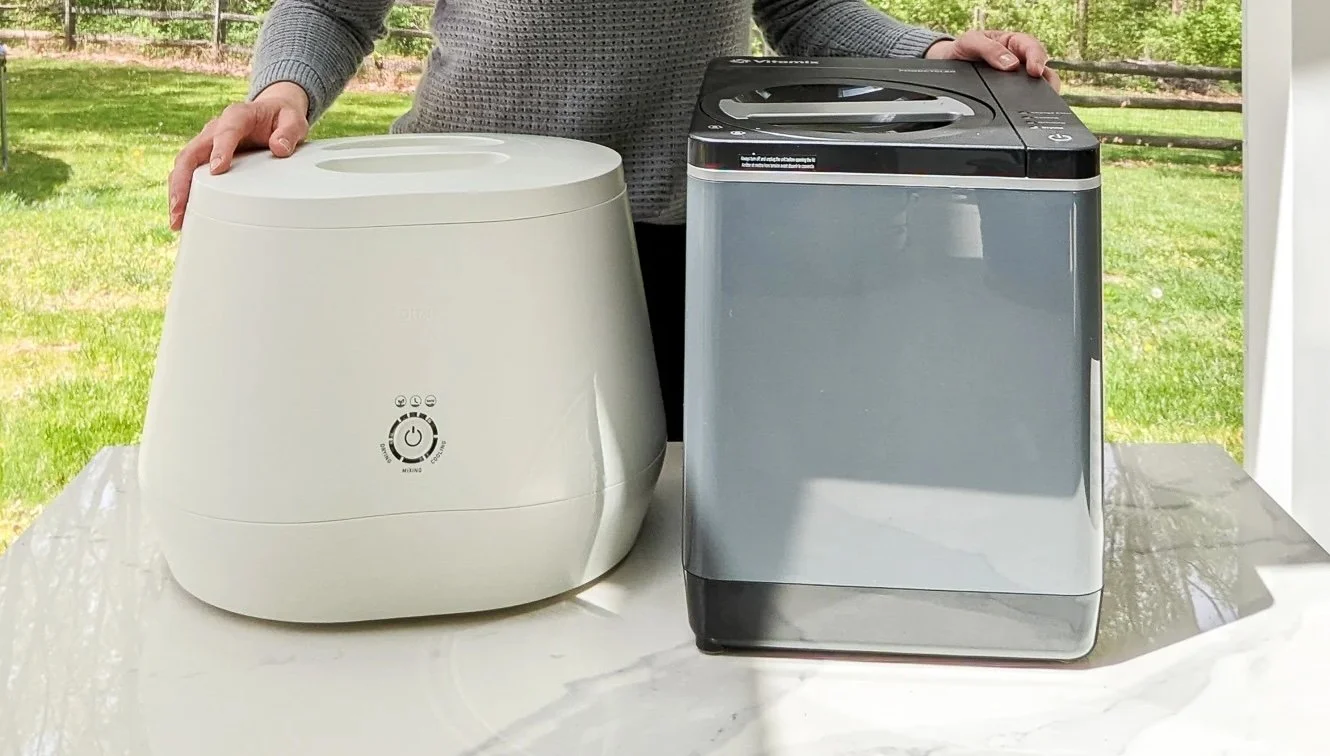
So. Many. People. ask me about countertop "composting" machines.
Here's the short answer: they don't compost. They're food grinders and dehydrators with a marketing budget, and they represent one of the most successful greenwashing campaigns of the 21st century. They sell convenience at the expense of literally everything else — everything hiding in plain sight, if we bother to look.
Let me show you what I mean.
What these machines actually do
They grind food. Then they dry it. That's it.
If you put your food scraps in a Cuisinart, ran it, and then set the whole thing inside a dehydrator, you'd accomplish the same thing. Sounds pretty stupid, right? That's because it is.
The only real difference is that these countertop units have grinding arms that turn slowly, so they can grind and heat and dry for hours at a stretch. What comes out the other end is ground-up, dehydrated food. From here on, I'm going to call it what it is: GUDF.
The companies already admit this
I want to get this out of the way early, because it saves us both a lot of argument.
When The Guardian investigated this category, the founder of Lomi acknowledged that what comes out of his machine is not compost. The product expert at Vitamix, which markets and distributes the FoodCycler in the US and Canada, said the same thing about theirs. His explanation for why they call it a composter anyway was refreshingly honest: it's the nearest concept a consumer already understands, so it's the word they reach for.
Read that again, because it's the whole scam in one sentence. They know it isn't a composter. They call it one because "composter" is a word you already trust.
Mill goes further and is more careful than its competitors — it calls its output "Food Grounds" rather than compost, and its own materials warn that the stuff can overwhelm your plants, grow mold, and attract animals if you add it to soil without composting it first. Mill also concedes that most households generate more of it than their garden can absorb.
That's not me. That's the manufacturer.
There's a related tell that Anne Marie Bonneau, the Zero-Waste Chef, caught. Several companies sell microbes as a separate optional purchase — you add them to the output after it comes out of the machine, put it in a different container, and set it aside for three or four weeks. That's an admission with a price tag on it. If composting happens in the second container, the appliance isn't a composter.
Other machines have you add microbe or enzyme packets during the cycle instead. Ron Alexander, a composting and environmental consultant, has explained why that doesn't rescue anything: those organisms are being asked to survive high heat and falling moisture, which are precisely the conditions the machine exists to create. A few hours of enzyme exposure isn't going to accomplish meaningful biological breakdown regardless.
And so does everyone who regulates this
CalRecycle, the California agency overseeing organic waste, states it flatly: dried food waste is not compost or a compost product, because these machines don't biologically decompose anything into a stable substance.
The US Composting Council — the industry's own trade association, not a critic — has taken the position that food dehydrators are not composters, that what they produce is a feedstock for composting rather than compost, and that these products should stop using the word "compost" in their names, their marketing, and their product descriptions.
So: the manufacturers know. The regulators have said so in writing. The industry body has formally asked them to stop. The marketing continues anyway.
What "compost" actually means
Compost is both a noun and a verb, and the verb is the whole point.
Compost is organic matter that has decomposed aerobically — with oxygen — into small uniform particles resembling a light, clay-like substance. That process takes months, whether it happens on a forest floor or in a bin you built out of pallets. While organic matter is decomposing, it is composting. When it's thoroughly decomposed, it has composted, and you have finished compost.
Finished compost has indicators you can verify with your own senses:
Smell. Faint and earthy. Barely anything at all.
Structure. A range of particle sizes that holds together when you squeeze a fistful.
Stability. A settled carbon-to-nitrogen ratio that stays put.
Life. It is biologically alive — microbes, fungi, the whole working population.
Benefit. It measurably improves soil and helps plants grow.
GUDF has none of these. Not one. It hasn't composted, because nothing in that machine composted it. Heat and blades are not microbes — in fact the heat does the opposite, sterilizing the material and killing whatever biology was present.
And "soil amendment" is not a vague honorific you get to award yourself. A soil amendment is any material — organic, meaning once alive, like compost; or inorganic, meaning never alive, like rock dust — that is added to soil and benefits the soil and the plants growing in it. Ground-up dehydrated food does not benefit soil. It does the opposite, and there's a mechanism.
The 10% problem
These companies tell you to mix GUDF into soil at a rate of no more than 10%. Sit with that number for a second, because it gives away the game.
First, the practical problem. Wasn't the entire pitch here convenience? So: do you have a spot in your yard where you can lightly till the top few inches of soil, on an ongoing basis, forever? If you have bare exposed earth — not lawn, not shrubs, not mulch — it's probably compacted. Tilling compacted soil is not fun. And if you're tilling down 2.5 inches, 10% means a quarter-inch of GUDF. Even for a household of one, you'll run out of square footage fast. You'll run out of motivation faster.
Second, and more important: why do you think the limit is 10%?
Here's the mechanism the marketing doesn't mention. Undecomposed organic matter doesn't feed your plants — it feeds the microbes that have to break it down first, and those microbes pull nitrogen out of the surrounding soil to do their work. That's nitrogen immobilization, and it's why the material is not just neutral but actively competitive with the plants you're trying to grow. The Illinois Food Scrap & Composting Coalition names this directly: dehydrated scraps still need to break down, and while they do, they can tie up nitrogen.
There's more going on than nitrogen. Dehydration concentrates salts and chlorides, and the resulting material tends toward high electrical conductivity and low pH — a combination soil scientists recognize on sight as hostile ground. The most concrete finding of all: studies have found that seeds often won't germinate in soil mixed with dehydrated food scraps.
Not "grow more slowly." Won't come up.
So the 10% ceiling exists because more than that causes visible damage. The companies know. That's the whole reason the number is in their instructions. And staying under the threshold doesn't make it good for your soil — it just makes the damage slow enough that you won't connect it back to the machine.
This is the sweeping-it-under-the-rug strategy. When a teenager is told to clean the living room, they might sneak some dust under the rug and hope nobody lifts it. A little bit, one time, and they get away with it. But start hauling shmutz from all over the house under that rug, week after week, and everybody's going to know.
Work GUDF into the same beds on a regular rotation and your plants will tell you.
"But the lab report says the nutrients are there"
You'll sometimes see a chemistry panel offered as proof — nitrogen, phosphorus, and potassium values landing in the same range as commercial soil amendments. It looks persuasive. It isn't.
Nutrient content is not nutrient availability. A whole chicken and a digested chicken have similar elemental composition; only one of them is feeding you. What makes finished compost valuable isn't the numbers on a panel, it's that the material is biologically stable and its nutrients are in forms plants can actually take up. GUDF fails on exactly that axis, which is why an NPK report doesn't rescue it — and why a lab result is the wrong instrument for the question being asked.
What happens when it gets wet
This is the property nobody advertises, and it matters more than any other single fact about this material.
GUDF isn't stable. It's food with the water removed — paused, not processed. Add moisture back and it resumes being exactly what it was: rotting food. The Guardian puts it plainly, and every composter who's handled the stuff knows it: unlike real compost, this material can rot once water is reintroduced.
So picture where you were told to put it. On top of your soil. In your beds. Outside. Where it rains.
"Just use it as mulch"
No.
Mulch is undecomposed organic matter — leaves, wood chips, straw — laid on top of soil, where it holds moisture and lets soil organisms flourish in the top few inches. Reasonable people can argue about whether wood chips look better than straw. All of it looks acceptable.
GUDF is still, functionally, food. Spread it on your soil and you're setting a table for rats, squirrels, possums, raccoons, skunks, and a long list of other guests.
Don't take my word for it — the composting consultant Ron Alexander ran the simplest experiment imaginable. He set two bowls in front of his dog: one of real finished compost, one of the output from an electric "composter." The dog ignored the compost and went straight for the dehydrated food waste.
That's the whole pest question, answered in about four seconds, by a dog. Alexander's soil trials went about as well — material from two of these machines molded, and killed some of the plants it was supposed to be feeding.
It also looks terrible by any standard of what's aesthetically passable.
So what do people actually do with it?
Here's the punchline, and it's a good one.
The companies tell users to put their GUDF in the municipal organics bin — the one picked up alongside the trash and recycling.
Read that again. A large appliance, shipped across an ocean, running for hours a day on your electricity, occupying prime kitchen real estate, so that your food scraps can be ground and dried and then… placed in the exact same green bin they'd have gone into anyway.
Hand, meet forehead.
And when people don't do that, they do something worse. Jen Panaro at Honestly Modern — who has owned three of these machines — asked owners what actually happens to their output. A striking number told her they throw it in the trash. Those were the enthusiasts. The early adopters. The people who cared enough to buy one.
(A side note on that green bin: big industry has coopted the word "compost" because compost is a commodity — it has value. Most green waste facilities are in the waste reduction business. What they produce lands somewhere between mulch and compost, and it's frequently contaminated with whatever constituents dumped in their containers — dog waste, motor oil, persistent herbicides. I wouldn't want it on the parkway in front of my house. And I would still, without hesitation, tell you to put your food scraps in that bin rather than run them through a machine first and then put them in that bin.)
The honest version of what this material is
GUDF isn't a product. But calling it a "feedstock" and stopping there is too generous, so let me be precise.
It's a feedstock you made worse.
Food scraps are already an excellent composting input. They arrive with their own water, their own structure, their own microbial population, and a particle size that leaves air gaps in a pile. Every one of those is an asset. Run them through one of these machines and you systematically strip all four:
You destroy the structure. Piles breathe. Coarse, irregular material holds free air space, and free air space is what keeps decomposition aerobic. Ground to a uniform powder, the material mats and compacts, the air is squeezed out, and the pile goes anaerobic — which is the smelly, slow, wrong kind of decomposition.
You concentrate everything. Pull the water out of food and what remains is several times denser in every constituent — nitrogen, sugars, salts, oils. A modest-looking bucket of GUDF is a far bigger load than it appears. Anyone eyeballing browns against greens by volume, which is how gardeners actually work, will get the blend badly wrong.
You concentrate the salts in particular. Soluble salts don't evaporate. They stay, and they accumulate in soil with repeated application. This is an under-discussed reason those application caps exist.
You smear the oils and fats through it. Grease doesn't dehydrate. It stays behind as residue coating every particle, which makes the material water-repellent — shedding moisture on the outside while staying soggy in the middle — and slows the microbes trying to colonize it.
You sterilize it. The heat kills the biology that would have started the work. The material can't self-start. It has to be re-inoculated by whatever you bury it in.
So yes: bury it deep in an active pile with plenty of coarse carbon around it and it will eventually compost. That's what the Illinois Food Scrap & Composting Coalition advises people who already own one of these machines, and it's correct advice.
But look hard at what that requires. A working pile. A steady supply of bulking material — hay, straw, wood chips. And enough skill to correct for every single thing the machine just did to your food. In other words, you have to be a composter already.
And if you're a composter already, those food scraps could have gone straight into the pile. In better condition. For free.
That's the part I want to land, because it's the whole thing: the machine doesn't turn waste into compost. It takes an easy feedstock and hands you back a difficult one.
About the energy
I want to be careful here, because I'd rather be right than loud.
A Lomi uses roughly a kilowatt-hour per cycle — less than a dishwasher. That's not catastrophic on its own, and if I told you it was, you'd rightly stop trusting me on everything else.
Here's the actual point. Composting uses zero. Not "less." Zero. So you're spending energy every day, plus the energy to manufacture and ship the appliance, plus whatever happens to it when it breaks in four years — and in exchange you get a material that's worse than what you'd get for free and that you still have to compost or dispose of.
And the cycle draw isn't the whole footprint. Several brands want you replacing charcoal filters roughly every six months — a recurring purchase, and a recurring piece of waste, generated by the appliance you bought in order to make less waste.
The problem isn't that the wattage is outrageous. It's that you're paying anything at all for a downgrade.
Why this makes composters angry
You might reasonably ask why people in my field get so heated about a kitchen appliance.
Ron Alexander said it better than I will: using the word "compost" loosely puts billions of dollars of composting infrastructure at risk, along with all the work that went into building it. When a consumer buys a machine labeled a composter, spreads the output on their garden, and watches their tomatoes struggle, they don't conclude that the appliance failed. They conclude that composting doesn't work.
That damage lands on every community composter, every municipal program, every farmer selling a quality product, and every person who was one good experience away from starting a pile. It's a public good being spent down for private marketing convenience.
What to do instead
The easy version, if you have municipal organics pickup: Keep a two-gallon bag in your freezer. Dump everything in it — the moldy yogurt, the mystery container, the nastiest thing in your fridge. It doesn't smell, it doesn't attract anything, and a fuller freezer actually runs more efficiently. On collection day it slides out of the bag in one frozen block and into the green bin. Rinse the bag, reuse it for years. Done. That's the whole system, and it costs nothing.
The version that actually matters: Compost it where you live. That's the single best thing you can do with your food waste — you take full responsibility for it, and you get finished compost out the other end.
The strong second-best: Find someone who will. A friend, a neighbor, a community garden, a local composter. These networks exist in more places than people realize, and they're growing.
I'll grant the one real argument on the other side: most Americans still don't have municipal food waste collection, and for people in apartments with no yard and no program, the options are genuinely thin. That's a real problem. But the answer to a public infrastructure gap is public infrastructure, not a $400 appliance that leaves you holding a material you still have to find a home for.
There is no shortcut, and you don't need one
Decomposition takes the time it takes. That's not a design flaw waiting on a better engineer — it is the process. Microbes eat, multiply, generate heat, hand off to the next community of organisms, and eventually hand you back something stable and alive and useful. That takes months. There is no version of it that happens in four hours, and a machine promising otherwise isn't accelerating the process. It's skipping it.
So what are these companies actually selling? Not compost — they've told us so themselves. They're selling the feeling of having composted: on demand, with a status light on the front, in under a day. That feeling is worth real money, which is exactly why there's so much money in it.
But the deeper con isn't the worthless output. It's the premise underneath the whole pitch — that the real thing is too hard for you. Too messy, too slow, too smelly, too technical. I've spent my career teaching composting to farmers, land managers, school groups, and plenty of people who arrived certain they'd kill anything they touched. Not one of them has failed at it. A pile of food scraps and a pile of leaves will compost whether or not you're any good at it, because you are not the one doing the work. The organisms are. Your job is to bring the materials and get out of the way.
That's what these appliances quietly take from you — and I don't mean the $400. I mean the understanding that you already have everything you need.
So freeze your scraps. Or build a pile. Or find the neighbor who has one. Any of those beats the machine on every measure that matters, including the one nobody puts in an ad: come spring, when you pull back the top of a finished pile and it's warm in your hands and it smells like the floor of a forest, you'll know precisely what you were being sold — and precisely what you'd have missed.
Steven Wynbrandt carries forward the work of some of the world's most committed biodynamic compost masters, an unbroken lineage descending directly from Rudolf Steiner, the founder of biodynamic agriculture. He has produced more than a million pounds of compost — by hand in Los Angeles, and with industrial machinery in Sonoma County — and makes the first and only hand-composted, Demeter-certified Biodynamic compost in the United States. His compost products are also CDFA-certified organic.
In 2018 he developed the Wynbrandt Method, a novel, no-turn, in-vessel system that makes it possible for schools and organizations to compost all of their food waste — including meat and dairy — safely, responsibly, confidently, and visibly on their own campuses. He works with schools and organizations across Southern California, and consults nationally and internationally with farms and land managers building custom compost systems to elevate soil health and keep organic material on the land.
Steven co-authored the Healthy Soils Strategy Document for the City of Los Angeles and sits on the city's Healthy Soils advisory panel. He has delivered expert testimony before the Los Angeles City Council on organic waste diversion and local composting infrastructure, and has trained students, faculty, chefs, and sustainability professionals at UCLA, USC, Santa Monica College, and K–12 schools throughout the region. His work has been featured in the Los Angeles Times, the Wall Street Journal, NPR, KCRW, CBS, and the Jewish Journal.