Why Most School Composting Programs Struggle — And How The Wynbrandt Method Solves the Problem
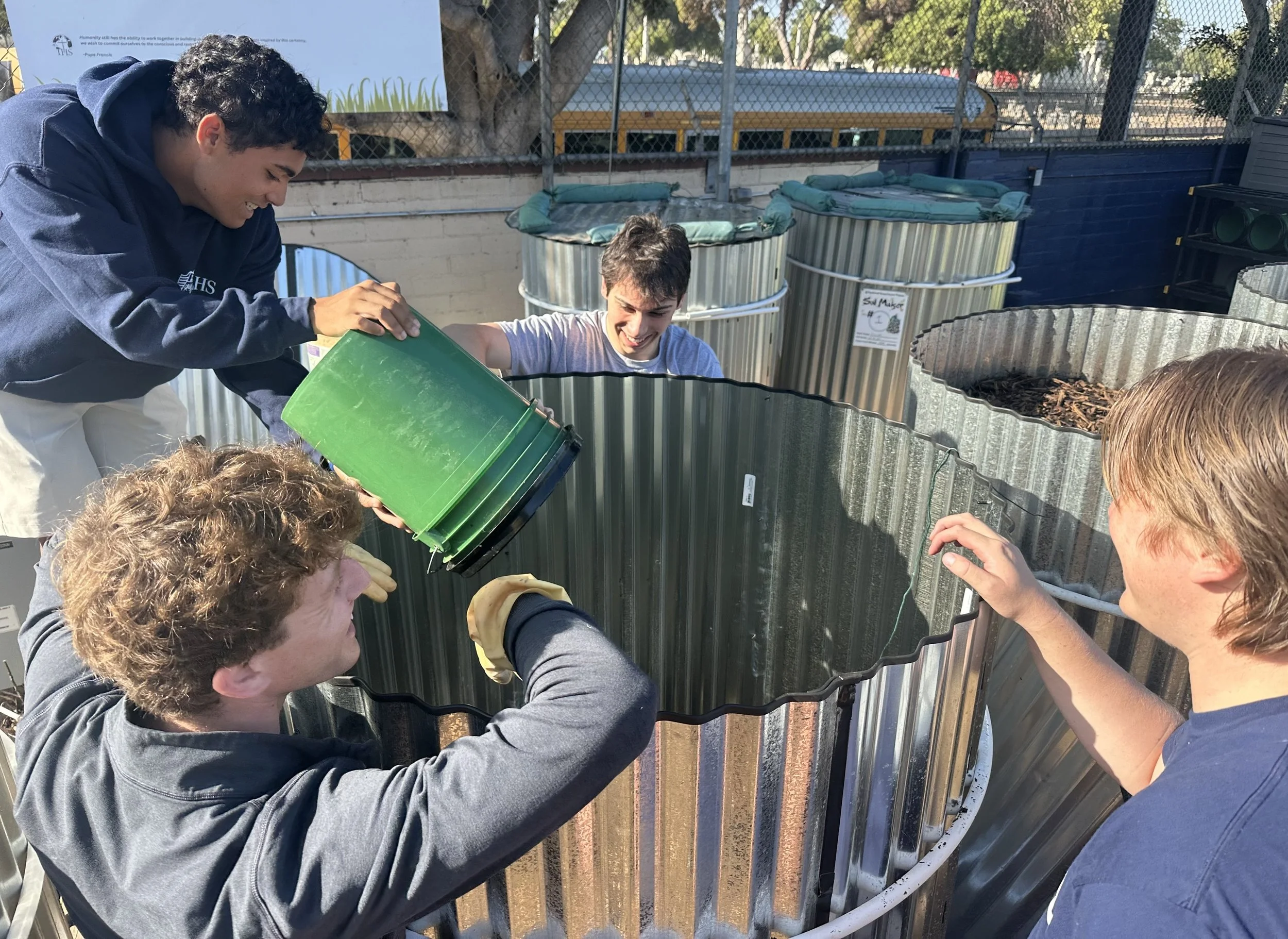
Schools across the country want to compost. They want to reduce waste, provide meaningful environmental education, and demonstrate their commitment to sustainability. Yet very few schools compost their food waste on campus, and the programs that do get attempted often struggle to last.
The reason is simple: traditional composting systems were not designed for schools.
Most composting methods require significant labor, ongoing troubleshooting, careful management, and a level of composting expertise that schools typically do not possess. Faced with that, most schools reasonably conclude that thousands of pounds of food waste is not something they can take on — and they are right to think so, given the options available to them.
Every problem people associate with composting — odors, flies, pests, slow decomposition, excessive labor, and inconsistent results — is ultimately a symptom of poor composting conditions. When compost conditions become suboptimal, particularly when they become anaerobic, problems emerge. Odors develop. Flies appear. Decomposition slows. Staff become frustrated. Programs lose momentum.
The Wynbrandt Method was developed to solve this challenge.
Rather than asking schools to become composting experts, the Wynbrandt Method makes it straightforward to create and maintain optimal composting conditions. By reducing the guesswork and dramatically reducing labor, schools can confidently compost large quantities of food waste while creating a powerful educational experience for students.
Space Constraints
Many schools assume they do not have enough space to compost significant quantities of food waste.
Traditional composting systems often require large piles, multiple bays, extensive turning areas, and substantial room to operate effectively.
The Wynbrandt Method utilizes a modular container system specifically designed for schools and organizations. These containers maximize composting capacity while minimizing footprint, making it possible to process large volumes of food waste in surprisingly compact spaces.
Schools do not need dedicated acreage, heavy equipment, or extensive infrastructure. The system scales easily by adding additional containers as needed, allowing schools to grow their composting capacity over time.
As a result, schools can divert the majority — and in some cases nearly 100% — of their food waste from the landfill while using only a modest amount of campus space.
Odors, Flies, and Pests
The greatest concerns schools have about composting are odors, flies, and pests.
These concerns are justified because many compost systems become anaerobic. When oxygen levels drop and the biology shifts in the wrong direction, compost begins producing foul odors and becomes attractive to flies and other pests.
These problems are not caused by composting itself. They are symptoms of poor composting conditions.
The Wynbrandt Method was specifically designed to make it simple and repeatable to create and maintain optimal aerobic composting conditions.
Through a carefully engineered combination of container design, materials, moisture management, airflow, and process, the system consistently supports the biology responsible for efficient aerobic decomposition.
When compost remains aerobic, there are no foul smells, no fly infestations, and no pest problems.
In essence, the Wynbrandt Method removes the guesswork from the most difficult aspect of composting. Fifteen years of professional compost-making expertise have been distilled into a system that allows students, teachers, facilities staff, and volunteers to achieve consistent success with confidence — with ongoing guidance from the person who developed it.
Food Waste Contamination
Many compost programs struggle with contamination because students are expected to sort waste correctly with little understanding of where that waste ultimately goes.
The Wynbrandt Farms program approaches contamination as an educational opportunity.
Food waste collection buckets are clearly labeled with photographs and simple instructions showing that all food is accepted — including fruits, vegetables, meat, dairy, bread, bones, pits, and peels. This dramatically simplifies sorting and reduces confusion.
Because the food waste is recovered and composted directly on campus, students regularly visit the compost area and witness the transformation of food scraps into finished compost. They learn firsthand why contamination matters and develop a sense of responsibility for the quality of the material they are helping create.
In the event that small amounts of contamination enter the system, they are typically easy to identify and remove during routine composting sessions before they become a significant issue.
Rather than relying solely on rules and signage, the program builds understanding through direct participation and experience.
Staffing and Supervision
Most schools do not have dedicated compost managers.
Teachers are already balancing full workloads. Facilities teams have numerous responsibilities competing for their attention. Student leadership changes every year.
Many compost programs depend heavily on one passionate teacher, parent volunteer, or sustainability coordinator. When that individual leaves, the program often disappears with them.
The Wynbrandt Method was specifically designed to minimize labor requirements and reduce dependence on individual champions.
The system requires a small fraction of the labor demanded by traditional turning methods. Frequent turning schedules, constant troubleshooting, and ongoing corrective management are largely eliminated.
Schools receive training, guidance, and long-term support to ensure the program remains successful year after year — including through staff turnover, which is the single most common reason school compost programs quietly end.
The result is a composting system that becomes a durable part of campus operations rather than an ongoing burden on staff.
Cost
Many schools assume composting requires substantial ongoing investment.
The Wynbrandt Farms program transforms a waste stream into a resource.
Schools divert food waste from disposal streams while simultaneously creating meaningful educational opportunities and producing valuable compost for campus gardens, trees, landscapes, and recreational turf.
Rather than paying indefinitely to haul food waste away, schools recover nutrients on-site and transform them into a high-value soil amendment that improves soil health and supports campus ecosystems.
The program delivers environmental, educational, and operational benefits while helping schools reduce their dependence on external waste-management systems.
Labor, Equipment, and Tools
Traditional school compost systems typically rely on three-bay compost bins that require regular turning with pitchforks and shovels.
While these systems can work, they often become labor-intensive and difficult to sustain long term. Staff and volunteers frequently find themselves spending significant time managing moisture, correcting imbalances, troubleshooting odors, and attempting to maintain proper composting conditions.
The Wynbrandt Method was developed to eliminate much of this labor.
The system significantly reduces the physical work required while making it substantially easier to maintain healthy composting conditions from the start. Rather than constantly reacting to problems, schools operate within a system designed to prevent those problems from occurring in the first place.
The result is a practical composting program that schools can sustain year after year without specialized equipment, extensive labor, or advanced composting expertise.
Educational Impact
Even when composting programs function operationally, many fail educationally.
Students dump food scraps into a container and never see what happens next. Composting becomes invisible and disconnected from learning.
The Wynbrandt Farms program transforms composting into a living educational system.
Students witness food waste becoming compost. They observe biological processes firsthand. They engage with soil ecology, nutrient cycling, decomposition, agriculture, climate science, and environmental stewardship through direct experience.
Rather than teaching sustainability as an abstract concept, students participate in a real-world system that demonstrates how waste becomes a resource and how healthy ecosystems function.
The result is one of the most tangible and meaningful environmental education experiences available on a school campus.
Why the Method Is Simple — and What Keeps It That Way
It is worth being clear about something that is easy to misread.
Composting thousands of pounds of food waste is not an inherently simple process. It is delicate, volatile, and unforgiving of small errors, and it always has been. What the Wynbrandt Method changes is not the nature of the process but where its difficulty is handled.
The complexity has been absorbed in advance — into the container design, the protocols, the recipes, the sequencing — so that the people doing the daily work are executing a clear process rather than diagnosing a biological system. That is what a career of professional compost-making produced: not a shortcut, but a structure that holds.
The ease is real. It is also manufactured, and it is maintained. A program that runs smoothly does not demonstrate that composting at scale is easy; it demonstrates that the system is working as designed and that someone with the relevant expertise is still watching it.
This is why participating schools work with Wynbrandt Farms on an ongoing basis rather than being trained once and left to continue alone. Conditions change. Seasons change. Staff change. The material keeps arriving. Ongoing oversight is what keeps a well-designed system performing like one, year after year — and it is what allows a school to take on real food waste with confidence rather than hoping for the best.
A System Designed Specifically for Schools
Most composting systems ask schools to adapt themselves to composting.
The Wynbrandt Method does the opposite.
It was developed specifically around the realities of school campuses: limited space, limited staff time, changing student populations, concerns about odors and pests, contamination challenges, and the need for meaningful educational outcomes.
At its core, the Wynbrandt Method solves the single greatest challenge in composting: creating and maintaining optimal composting conditions.
When those conditions are right and properly maintained, composting becomes something a school can actually run.
The result is a proven system that allows schools to compost large quantities of food waste safely, cleanly, efficiently, and successfully — while providing students with a direct experience of ecological responsibility and regeneration.
Steven Wynbrandt carries forward the work of some of the world's most committed biodynamic compost masters, an unbroken lineage descending directly from Rudolf Steiner, the founder of biodynamic agriculture. He has produced more than a million pounds of compost — by hand in Los Angeles, and with industrial machinery in Sonoma County — and makes the first and only hand-composted, Demeter-certified Biodynamic compost in the United States. His compost products are also CDFA-certified organic.
In 2018 he developed the Wynbrandt Method, a novel, no-turn, in-vessel system that makes it possible for schools and organizations to compost all of their food waste — including meat and dairy — safely, responsibly, confidently, and visibly on their own campuses. He works with schools and organizations across Southern California, and consults nationally and internationally with farms and land managers building custom compost systems to elevate soil health and keep organic material on the land.
Steven co-authored the Healthy Soils Strategy Document for the City of Los Angeles and sits on the city's Healthy Soils advisory panel. He has delivered expert testimony before the Los Angeles City Council on organic waste diversion and local composting infrastructure, and has trained students, faculty, chefs, and sustainability professionals at UCLA, USC, Santa Monica College, and K–12 schools throughout the region. His work has been featured in the Los Angeles Times, the Wall Street Journal, NPR, KCRW, CBS, and the Jewish Journal.